
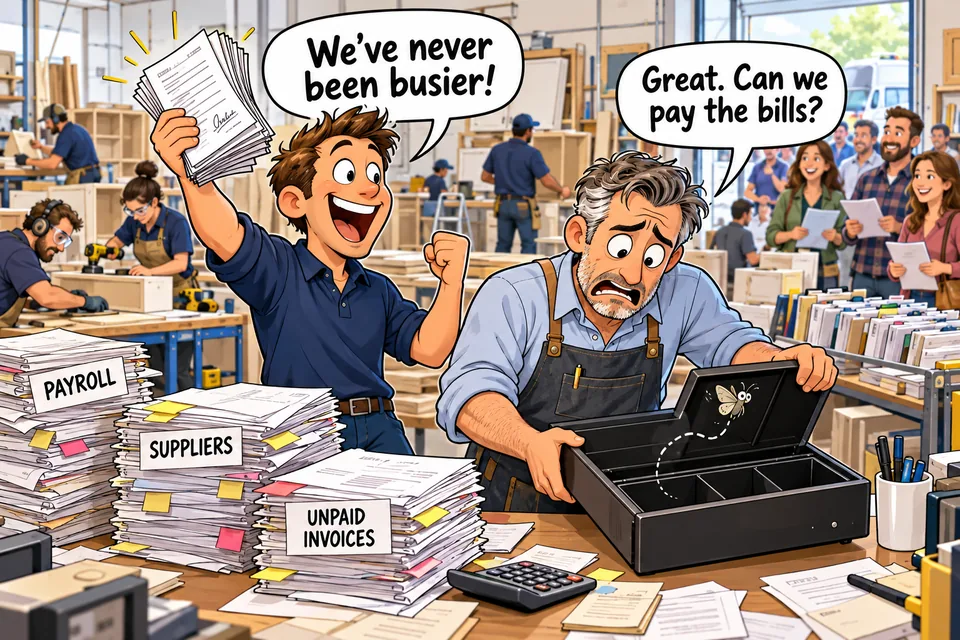
A busy business can still run out of cash.
Being a skilled builder, attorney, restaurateur or specialist does not automatically prepare you to manage the finances of a business. You may understand your customers and deliver excellent work, while finding it much harder to judge costs, margins, payment timing and the commitments behind your bank balance.
A company can win more customers and earn a profit on its work, yet still be unable to pay its obligations when they fall due. The problem is often the gap between paying for the work and collecting payment for it. Growth can widen that gap: more jobs may mean more materials, payroll and subcontractor costs before more cash arrives.
Sales
Work sold or revenue recorded, depending on the measure. It is not necessarily money collected.
Profit
Revenue less the costs recognized for the period. The accounting method affects when it appears.
Available cash
Money on hand, considered alongside what must be paid and when. Some of it may already be needed for promised work.
Cash pressure is a widespread concern. In the Federal Reserve Banks' 2024 Small Business Credit Survey, 51% of small employer firms reported uneven cash flows as a financial challenge. The 2025 report describing that survey concerns operating or temporarily closed firms; it does not establish what proportion of businesses failed because of cash flow.
A timing shortage and a loss-making business also need different responses. Changing when customers pay can help a viable business fund its work. It cannot permanently repair prices that fail to cover costs.
See this distinction in the example profit-versus-cash report, based on a fictional company's simulated records.
Who is watching the complete financial picture?
A small business may outsource selected bookkeeping functions: recording transactions, reconciling accounts, tracking receivables or preparing reports. Those tasks matter. But the engagement may not include forecasting cash, assessing project funding or challenging spending decisions.
The records can be accurate while nobody is asking whether the money needed to finish existing jobs will still be there next month. If the owner lacks financial management experience, that gap can be difficult to recognize.
The issue is the scope of responsibility, not whether the bookkeeper is internal or outsourced. Some outsourced providers offer excellent controller or CFO services. An internal bookkeeper is not automatically a financial controller. Ask who is responsible for the whole picture, what they are expected to assess and who acts on the findings.

Information must also be understood. A report showing growing receivables or future liabilities may not tell an inexperienced owner, in terms they recognize, why another sale could make the cash shortage worse. Changing advisers does not remove the underlying commitments.
Having the figures is one step. Understanding what they mean for your next decision is another.
EXAMPLE 01 · CUSTOM CONSTRUCTION
The customer deposit trap.
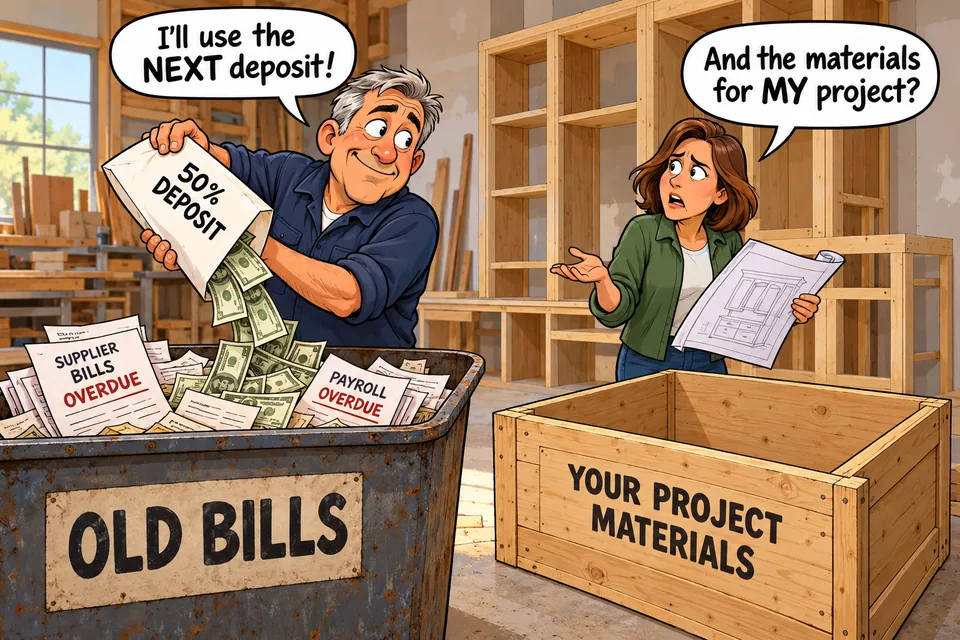
An anonymized example drawn from Tim Barrie's experience. It describes a pattern he observed, rather than an independently audited case study.
A custom construction business collects a 50% deposit and starts a project. The bank balance looks healthy, so the owner spends the cash on other commitments without allowing enough for the work the new customer has paid to receive.
The owner also sees a substantial pipeline of deals expected to close in the coming months. That creates reassurance: the next deposit will cover the bills. But a promising pipeline is not cash in the bank, and a new deposit brings a new project to fund.
- The deposit arrives and creates a feeling of financial comfort.
- Cash is spent without reserving enough to deliver the project.
- Materials are needed, but the money is short.
- The next customer's deposit helps pay for earlier work.
- The funding gap carries forward, while delays postpone completion payments.
Sales confidence has outrun cash planning. Each additional project can increase the obligations the business struggles to meet, even if its estimated margin looks attractive.
The practical principle is to plan enough cash to meet project costs and other obligations as they fall due, allowing for progress payments. That does not mean every business must place every deposit in a separate account or reserve it in full. Appropriate arrangements depend on costs, terms and any applicable requirements.
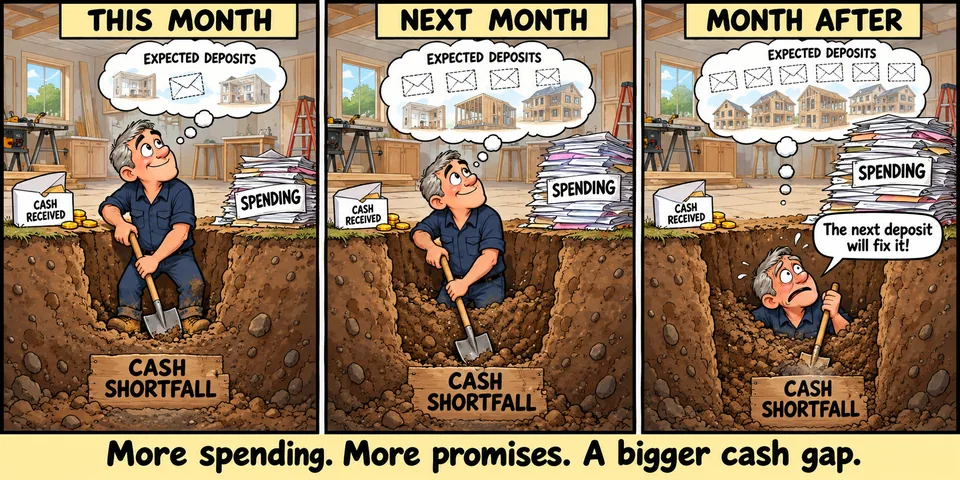
The ever-expanding cash gap: a slow business killer.
A small cash deficit each month can grow into a mountain of commitments that eventually buries your business. The shortfall does not reset when a new month begins. If you keep spending more cash than you collect, yesterday's shortage is still there when tomorrow's bills arrive.
Each new customer deposit feels like a rescue. But much of it goes straight into older commitments, leaving too little to deliver the project that brought the money in. The owner looks at the sales pipeline and thinks, “Once those next deals close, we'll be fine.” Meanwhile, spending continues against money that has not yet arrived.
This can continue for months. Sales may grow. The business may look busy and successful. Behind the scenes, suppliers wait longer, materials arrive late, projects stall and final payments get pushed further away. The business becomes increasingly dependent on the next deposit just to keep moving.
Eventually, a late payment, a delayed sale or an unexpected cost can expose how deep the hole has become. What looked like a manageable shortage has grown beyond the business's ability to fund the work it has already promised.
More sales can keep this cycle alive while making the eventual cash crisis bigger.
EXAMPLE 02 · SPECIALIST HOME SERVICING
The work is complete. The cash never arrives.
An anonymized example based on an experience reported by a client.
A specialist servicing business travels to customers' homes and completes repairs. Some customers then dispute aspects of the work and leave invoices unpaid. The business has already carried the cost of attendance, labor and possibly parts, and has limited resources to pursue collection.
A busy service schedule and a growing receivables balance can conceal this exposure. Money recorded as owed is not money available to pay the next technician or supplier. Some overdue amounts may ultimately be uncollectible.
One option Tim suggested was collecting the agreed call-out or diagnostic fee upfront. That would protect the cost of attending. Additional repairs and components would still need clear prices, authorization and payment terms. The business's specialist position may help it introduce those terms, but customer acceptance needs testing.
A wealthy customer can still be difficult to collect from.
Construction clients have also reported difficulty collecting final balances after substantial installation work. A disagreement can lead to delayed payment or a negotiated reduction after most costs have already been incurred. A customer's apparent wealth does not guarantee straightforward collection.
Some complaints are legitimate, and customers deserve the agreed work. Clear specifications, documented changes, milestones and acceptance criteria help both sides understand what is expected. The objective is fair payment for agreed work, with less uncertainty for everyone.
EXAMPLE 03 · HOLISTIC WEB PRESENCE
Rethink the assumptions behind how you get paid.
Optimize your business for cash flow and stability.
When Tim first established Holistic Web Presence, he worked with a website developer who charged 50% upfront and the balance on completion. For a hypothetical $10,000 website, that meant $5,000 now and $5,000 later.
The difficulty was defining and reaching completion. Clients could delay supplying content, disagree that the website was finished or abandon their plans. The developer could do substantial work while the final payment remained out of reach. Taking down a website offered little leverage if the client no longer wanted the business.
Tim chose a different model for Holistic Web Presence: a monthly retainer paid upfront, with work delivered over time. He was told clients would not accept it. His experience was that they did, and the model became the basis of the business.
A delay in providing client materials no longer also delays payment for the ongoing engagement. Clients know their monthly expense and can budget for it. The agreement still needs to make the scope, responsibilities, service and cancellation arrangements clear.
Automate the collection, too.
Holistic Web Presence also changed its payment policy to accept only automated credit card payments for the monthly retainer. Previously, Tim would often spend time chasing a payment a client said was “in the mail,” waiting for the check to arrive and then depositing it. That added administration and uncertainty to each month's collections.
Card payments incurred transaction fees. In Tim's experience, those fees were more than outweighed by the reduction in chasing and administration and the greater reliability of payments. Together, upfront monthly retainers and automated collection made the business more stable and its cash receipts more predictable.

Cash flow is influenced by the design of your business, including when payment becomes due and what it depends on.
Monthly retainers will not suit every business, and predictable receipts still need to cover delivery costs. The transferable lesson is to examine who controls the event that releases payment and how much cost the business carries while waiting. It may be easier to improve that arrangement than to chase money after the work is done.
Other ways to rethink how customers pay
The useful question is: “Why are we financing the customer's purchase, and could we structure the arrangement differently?” These illustrative applications of established payment models offer other starting points.
Background on these models: advance and stage payments, prepaid credits, recurring payment collection, payment and credit terms, and customer installment providers.
These are options to evaluate, not universal rules. Agree appropriate terms before work begins, with clear scope, cancellation and refund arrangements. The principle is to align cash receipts with the costs and commitments the business takes on, while keeping the arrangement fair and worthwhile for customers.
How Owner Insights AI can help.
Owner Insights AI prepares and maintains relevant business information so owners and their advisers can ask questions in plain English. With the right records and business context, it can help investigate cash pressures, identify opportunities to improve payment timing and brainstorm practical responses.

Spot the pressure
Investigate changes in cash, overdue invoices, purchasing and the commitments attached to active work.
Understand the reason
Connect the figures to how the business operates, with follow-up questions and explanations in ordinary language.
Explore a response
Compare scenarios and possible process changes with the owner, bookkeeper or CPA before deciding what to do.
The discussion might reveal that invoices are overdue because payment depends on customer approval, or that deposits are being spent before project costs fall due. Those causes may require the owner to explain the process; an accounting export alone will not necessarily contain them. See the business questions that need information beyond accounting.
AN ILLUSTRATIVE PLAIN-ENGLISH EXPLANATION
Your bank balance has increased, but much of that money is needed to finish projects you have already sold. Using it elsewhere could delay those projects and the final payments you expect. Another deposit brings another project to fund, so it may not resolve the shortage.
The owner can then ask: “Show me which projects,” “Explain that more simply,” or “What would need to change?” Clear explanations help understanding; they cannot guarantee someone will accept an uncomfortable answer or act on it.
Owner Insights AI supports bookkeepers and CPAs as well as owners. It helps make their information more accessible and prepares better questions for their expertise.
Questions to build into your dashboard.
A dashboard can be tailored during implementation to put recurring cash flow questions within easy reach. These examples show what owners could investigate and what information would be needed. They are not live analyses of your business.
01Why is cash falling while sales are growing?+
Why ask?
Sales are increasing, but you’re finding it harder to pay the bills. Understanding why helps you decide whether the business can afford more work or needs to collect payments sooner, change payment terms or reduce spending.
Information needed
Financial reports covering the same periods, bank balances and transactions, unpaid customer invoices, bills you still owe, and records of stock purchases or project costs.
02How much of the money in our bank account is already committed?+
Why ask?
Your bank balance may look healthy, but some of that money is already needed to finish existing jobs and pay upcoming bills. Before spending it or taking on another commitment, you need to understand how much is already spoken for and how much will remain after those costs are paid.
Information needed
Current bank balances, estimated costs to finish existing jobs, customer payments still expected and when they should arrive, purchases you’ve agreed to make, and upcoming wages, taxes and other bills.
03Which overdue invoices need attention first?+
Why ask?
Customers owe you money, but you have limited time to chase payments. You need to know which unpaid invoices matter most to your cash position and which may become harder to collect if you leave them longer, so you can focus your efforts where they’re most needed.
Information needed
Each unpaid invoice, its amount and due date, the customer’s payment history, notes from previous follow-ups, any promises to pay, and any disputes holding up payment.
04What happens if expected customer payments arrive 30 days late?+
Why ask?
You’re counting on customer payments to cover upcoming bills. If those payments arrive a month late, could you still pay wages, suppliers and other commitments on time? Understanding where a delay would leave you short gives you time to prepare.
Information needed
Your current bank balance, customer payments expected and their likely arrival dates, upcoming bills and when they must be paid, and the minimum cash cushion you want to keep.
05Will taking on another large project improve cash flow or make the shortage worse?+
Why ask?
A large new project may look like the answer to your cash shortage, especially if it brings a deposit. But if you have to pay for materials and wages before the next customer payment arrives, it could leave you even shorter of cash. You need to know whether you can fund the new work while still covering your existing jobs and bills.
Information needed
What the project includes, the deposit and later customer payments and when they’re expected, estimated costs and when they must be paid, whether your team can handle the extra work, and your existing cash commitments.
06Which parts of our payment arrangements force us to spend money before we collect it, and what alternatives could reduce that gap while remaining attractive and fair to customers?+
Why ask?
Your cash pressure may come partly from when you ask customers to pay. If you routinely cover costs before collecting, you need to understand whether different payment arrangements could reduce that strain while keeping your services attractive and your terms fair to customers.
Information needed
Your customer agreements, when payments are due and when they actually arrive, any delays or disputes, the costs of doing the work and when you pay them, other upcoming bills such as wages, rent, loan payments and taxes, and how your business delivers and charges for its services.
Other useful follow-ups include: “What if we collect call-out fees upfront?” “What if a final balance is reduced?” and “Which inventory purchases could be timed differently without disrupting delivery?” The answer should distinguish what the records show from an option that still needs evaluating.
Start with the cash decisions behind the numbers.
Ask who is watching the complete financial picture. Then examine what cash is already committed, when customer money is expected to arrive and what your payment arrangements require you to fund first.
A successful sale is the beginning of an obligation to deliver. A completed job is not always a collected payment. Understanding both can help you recognize a cash problem while there is still time to respond.
Owner Insights AI helps you understand where cash is getting stuck, spot potential problems and explore practical changes with your bookkeeper or CPA.